
When is a GST E-Way Bill legally required, and how is its travel validity calculated?
Under Rule 138 of the CGST Rules, 2017, an E-Way Bill must be generated prior to commencing the movement of goods in a motorized vehicle whenever the consignment value exceeds ₹50,000 (taxable value plus GST). For interstate transit, the threshold is uniformly ₹50,000, while several states permit ₹1,00,000 for intrastate movements. The validity is strictly calibrated at 1 day for every 200 km (or part thereof) for regular cargo, and must be extended within 8 hours before or after expiry if vehicle breakdown occurs.
1. State-Wise Intrastate Threshold Deviations
While interstate movement is uniformly fixed at ₹50,000, state commercial tax departments have notified relaxed limits for shipments moving entirely within their territory:
| State / Union Territory | Interstate Limit | Intrastate Limit | Special Conditions |
|---|---|---|---|
| Delhi | ₹50,000 | ₹1,00,000 | Exempt for all goods moving within Delhi up to ₹1 Lakh |
| Maharashtra | ₹50,000 | ₹1,00,000 | ₹1 Lakh limit applies to all commodities across the state |
| West Bengal | ₹50,000 | ₹1,00,000 | ₹1 Lakh limit, but ₹50,000 for specified sensitive goods |
| Bihar | ₹50,000 | ₹1,00,000 | ₹1 Lakh across state except specified tobacco and iron/steel |
| Gujarat | ₹50,000 | ₹50,000 | Exempt for 19 specified items moving intrastate regardless of value |
| Tamil Nadu / Karnataka | ₹50,000 | ₹50,000 | Standard default threshold of ₹50,000 strictly enforced |
2. Part A vs Part B: When is an E-Way Bill Truly Valid?
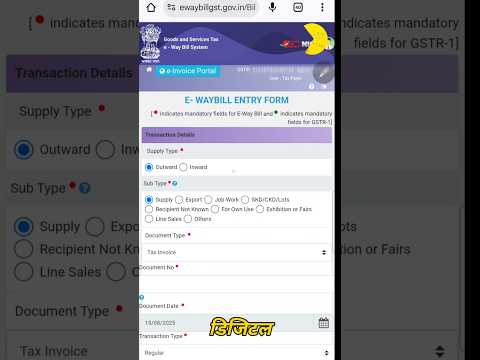
Filled by the consigner or recipient. Contains Supplier GSTIN, Recipient GSTIN, Place of Delivery (PIN Code), Document Number (Invoice/Challan), Total Value, and HSN Code. Generating Part A reserves the transaction, but is NOT valid for transport on highways without Part B.
Filled by the transporter or consigner. Contains the motorized Vehicle Registration Number, Railway Receipt (RR) No, Airway Bill (AWB) No, or Bill of Lading. Once Part B is updated, the 12-digit E-Way Bill becomes active and its validity timer starts ticking.
Under the third proviso to Rule 138(3), if goods are transported from the consigner's factory or shop to the transporter's hub within the same state for a distance of up to 50 km, updating Part B is exempt. Only Part A must be generated.
3. 200 km/Day Validity Computation Matrix
Effective from 1st January 2021 (Notification 94/2020-CT), the transit speed benchmark was doubled from 100 km to 200 km per day:
| Type of Conveyance | Distance Range | Validity Period |
|---|---|---|
| Regular Cargo (Normal Trucks) | Up to 200 km | 1 Day |
| Regular Cargo (Normal Trucks) | For every additional 200 km (or part thereof) | +1 Additional Day |
| Over Dimensional Cargo (ODC) | Up to 20 km | 1 Day |
| Over Dimensional Cargo (ODC) | For every additional 20 km (or part thereof) | +1 Additional Day |
Example: A truck carrying auto parts from Pune to Delhi (distance 1,420 km) gets 8 days of validity (1,420 ÷ 200 = 7.1 → rounded up to 8 days). The day of generation ends at midnight of the following day.
4. The 8-Hour Validity Extension Protocol
If a vehicle suffers a mechanical breakdown, tyre burst, traffic jam on national highways, or transshipment delay, the validity must be extended to prevent interception:
The consigner, recipient, or transporter can log into ewaybillgst.gov.in → e-Waybill → Extend Validity. This option is active strictly within 8 hours before expiry and within 8 hours after expiry. You must enter the current place (PIN code), state, reason for extension, and updated vehicle registration number.
5. Section 129 Seizures: 200% Penalty & MOV Process
If goods are intercepted without an E-Way Bill or with an expired E-Way Bill where the owner comes forward, the mandatory statutory penalty is equal to 200% of the tax payable on the consignment. If the owner does not come forward, penalty increases to 50% of the value of goods or 200% of tax, whichever is higher.
- Form GST MOV-02: Order for physical verification of vehicle and cargo within 24 hours.
- Form GST MOV-06: Order of detention of vehicle and seized goods.
- Form GST MOV-07: Show Cause Notice specifying the 200% penalty calculation.
- Form GST MOV-09: Final demand order passed by the proper tax officer.
6. Defense Against Harassment: CBIC Circular No. 64/38/2018-GST
Tax officers often threaten 200% penalties for minor typing slips. The CBIC has issued explicit instructions that for the following 6 minor clerical mistakes, goods cannot be seized, and only a token penalty of ₹500 CGST + ₹500 SGST (Total ₹1,000) under Section 125 can be imposed in Form GST MOV-02:
- Spelling mistake in consignor or consignee name, but GSTIN is completely accurate.
- Error in PIN code, provided the destination address and city are correctly spelled.
- Error in 1 or 2 digits of the vehicle number (e.g. typing DL-1A-1235 instead of DL-1A-1234).
- Error in 1 or 2 digits of the document number (invoice number).
- Typo in HSN code, where first 2/4 digits and tax rate are correctly declared.
Recommended Video Tutorials & Practical Guides

7. Frequently Asked Questions (FAQs)
Is an E-Way Bill required for movement of exempt goods (e.g. fresh fruits)?▼
No. Under Rule 138(14), goods specified in the annexure (such as fresh fruits, vegetables, live animals, unbranded food grains, and curd) are completely exempt from E-Way Bill requirements regardless of value.
Can an E-Way Bill be generated if my GSTR-3B return is pending?▼
Under Rule 138E, if a registered person fails to file GSTR-3B or CMP-08 for 2 or more consecutive tax periods, the GST portal automatically blocks E-Way Bill generation on their GSTIN for outward supplies.
Can an E-Way Bill be cancelled if the order is cancelled?▼
Yes, an E-Way Bill can be cancelled within 24 hours of generation, provided the goods have not been intercepted or verified in transit by tax officers.
Automate Your Invoicing & Instant E-Way Bill Generation
Generate compliant B2B invoices and calculate taxes seamlessly with GST Munshi. Also explore our guide on GST E-Invoicing Rules.