
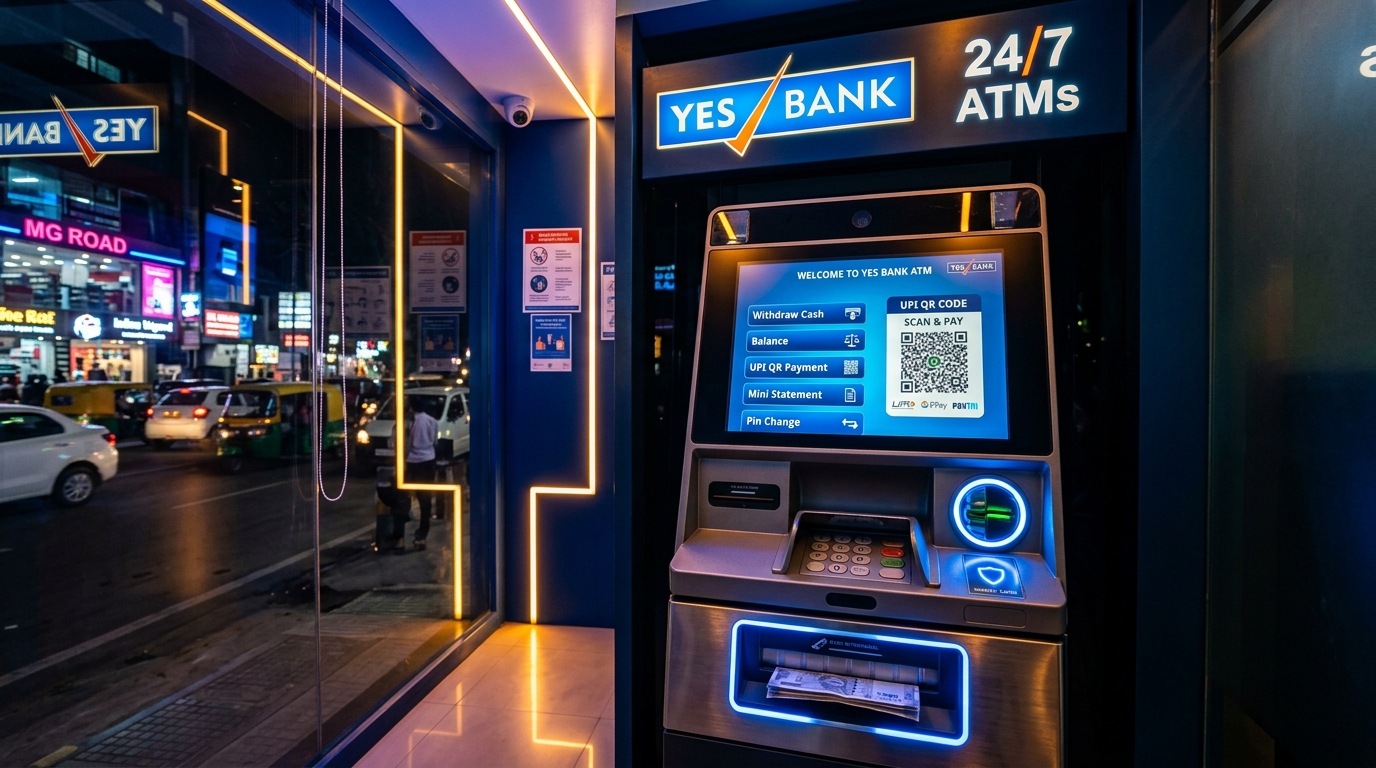
1. What is an ATM? Definition, Full Form & History in India
An ATM, short for Automated Teller Machine, is an advanced electro-mechanical data processing terminal that connects directly to a bank’s centralized host computer system. It empowers account holders to complete routine banking transactions—including cash withdrawals, balance inquiries, mini-statement generation, PIN generation, and cash deposits—anytime, 24/7/365, without interacting with a human bank clerk.
Before the invention of ATMs, accessing one’s own money required physically standing in long bank queues with a signed withdrawal slip or bearer cheque during strict banking hours (typically 10:00 AM to 2:00 PM). The ATM decentralized cash liquidity, fundamentally changing the global retail economy.
The Barclays Enfield Breakthrough
Scottish inventor John Shepherd-Barron conceived the idea of a 24-hour chocolate vending machine that dispensed banknotes. The first automated cash machine was commissioned by Barclays Bank in Enfield, North London. It operated using paper vouchers impregnated with mildly radioactive Carbon-14 and a 6-digit PIN (later standardized to 4 digits by Shepherd-Barron’s wife Caroline).
HSBC Mumbai & The NPCI NFS Revolution
India’s first ATM was installed in 1987 by HSBC (Hongkong and Shanghai Banking Corporation) at its Andheri branch in Mumbai. By the early 2000s, the Reserve Bank of India and NPCI created the National Financial Switch (NFS), interconnecting all Indian bank ATMs so that an SBI customer could withdraw cash at an HDFC or ICICI ATM seamlessly.
2. ATM Hardware Architecture: Inside the Anatomy of the Cash Machine
An ATM is not merely a computer; it is an industrial robotic safe. It combines encrypted input modules, high-precision mechatronics, and bank-grade physical armor. Click on any module below to inspect its internal specifications:
EMV Chip & NFC Card Reader
Reads cryptographic data stored on the microchip of ISO/IEC 7816 smart debit cards, or detects contactless RFID/NFC cards.
Motorized dip slot with anti-skimming bezel and magnetic heads.
Authenticates card authenticity and prevents clone-card counterfeit execution.
The Two Physical Halves of an ATM: Upper Fascia vs Lower Vault
Contains the interactive peripherals: Card Reader, Touchscreen display, Encrypting PIN Pad (EPP), Thermal receipt slot, and Surveillance pinhole camera. Accessible to the customer.
A heavily reinforced armored steel safe weighing over 400 kg to 900 kg. Houses 4 to 6 currency cassettes (holding ₹500, ₹200, and ₹100 notes), picker modules, optical double-detect sensors, and reject purge bin. Only cash-in-transit (CIT) guards with dual combination keys can open it.
3. The Backend Transaction Route: How Money Flows in 4 Seconds
When you insert your debit card or scan a UPI QR code at an ATM, complex cryptographic handshakes occur across thousands of kilometers in under four seconds:
Card Insertion & Hardware Encryption
The card reader reads the EMV chip. You type your 4-digit PIN on the Encrypting PIN Pad (EPP). The keypad immediately scrambles the PIN into an encrypted PIN Block using triple DES (3DES) or AES-256 keys. The plain PIN is never exposed to the ATM’s internal computer memory.
Acquirer Bank & ISO 8583 Message Formulation
The ATM packages the transaction details into a standardized ISO 8583 financial message payload (including transaction type, requested amount ₹2,000, encrypted PIN block, and terminal ID) and transmits it over an encrypted VPN tunnel to the Acquirer Bank (the bank operating the ATM).
Routing via NPCI National Financial Switch (NFS)
If the ATM belongs to a different bank (e.g., you are using an SBI card at an HDFC ATM), the Acquirer Bank routes the message to the National Payments Corporation of India (NPCI) National Financial Switch (NFS) in Mumbai. NFS decodes the Bank Identification Number (BIN) and forwards the request to your card-issuing bank (Issuer).
Core Banking Solution (CBS) Balance Check & Dispense Command
Your bank’s Core Banking Solution (TCS BaNCS, Finacle, or Flexcube) checks if the PIN matches, verifies sufficient balance, and checks daily limits. It deducts the amount from your ledger and fires an approval message (Response Code ‘00’) back through NFS to the ATM. The ATM dispenser spins the cassettes, counts the exact notes, presents them at the shutter slot, and issues your receipt.
4. The 7 Colorful Types of ATMs in India (White, Brown, Green, Pink...)
In banking examinations, commerce curriculums, and financial discussions, ATMs in India are classified into color-coded labels and operational models:
White Label ATM (WLA)
Tata Indicash, India1 ATM, Hitachi Money SpotBrown Label ATM (BLA)
Diebold Nixdorf or NCR hardware sponsored by SBI, PNB, or Canara BankGreen Label ATM
NABARD-sponsored rural agricultural credit ATMsYellow Label ATM
E-Commerce order collection & refund payout terminalsOrange Label ATM
Share market transaction & investment kiosksPink Label ATM
Bank of Baroda / Union Bank Women Exclusive KiosksMicro ATM (AePS Kiosk)
PayPoint, Spice Money, Fino Payments Bank handheld biometric terminals5. Next-Gen ATM Innovations: CRMs, Micro ATMs & UPI-ATM (ICCW)
The ATM industry in India has undergone a massive technological upgrade driven by NPCI and RBI:
Cash Recycler Machine (CRM / CDM)
Traditional ATMs only dispense money, requiring bank staff to refill them daily. A Cash Recycler Machine accepts cash deposits, runs ultraviolet and magnetic counterfeit scans on every banknote, credits your account in real-time, and recycles those exact genuine notes to subsequent users withdrawing cash.
Micro ATM (AePS Kiosks)
Equipped with a biometric fingerprint reader and thermal receipt printer, Micro ATMs are operated by local shopkeepers and Bank Mitras. A customer does not need a card or smartphone—they simply provide their 12-digit Aadhaar number, scan their thumb, and withdraw cash directly from their bank account.
UPI-ATM Cardless Cash (ICCW)
Allows you to withdraw cash without inserting a debit card. You select “UPI Cash Withdrawal” on the ATM screen, enter the amount, scan the single-use dynamic QR code using Google Pay, PhonePe, or BHIM, and authenticate with your UPI PIN. Eliminates card skimming risks 100%.
6. RBI ATM Transaction Limits, Interchange Fees & Daily Bank Caps (2026)
The Reserve Bank of India strictly regulates the number of free monthly ATM transactions and maximum customer charges:
Comparative Daily Cash Withdrawal Limits Across Top Indian Banks
| Bank Name | Debit Card Tier | Daily ATM Cash Limit | Online E-Com Limit | OTP Mandate |
|---|---|---|---|---|
| State Bank of India (SBI) | Classic / Global RuPay & Visa | ₹20,000 / day | ₹50,000 / day | Yes (above ₹10,000 24x7) |
| State Bank of India (SBI) | Platinum International | ₹1,00,000 / day | ₹2,00,000 / day | Yes (above ₹10,000 24x7) |
| HDFC Bank | Millennia / EasyShop Debit | ₹50,000 / day | ₹3,50,000 / day | Standard SMS OTP on mobile |
| HDFC Bank | Imperia Platinum Chip | ₹1,00,000 / day | ₹5,00,000 / day | Standard SMS OTP on mobile |
| ICICI Bank | Coral / Titanium Debit | ₹50,000 / day | ₹1,00,000 / day | Standard SMS Alert |
| ICICI Bank | Sapphiro Debit Card | ₹1,50,000 / day | ₹3,50,000 / day | Standard SMS Alert |
| Axis Bank | Liberty / Priority Debit | ₹50,000 to ₹1,00,000 | ₹3,00,000 / day | Standard SMS Alert |
| Punjab National Bank (PNB) | RuPay Platinum | ₹50,000 / day | ₹1,25,000 / day | Yes (above ₹10,000 at night) |
| Bank of Baroda (BoB) | RuPay Classic / Platinum | ₹25,000 to ₹50,000 | ₹1,00,000 / day | Yes (above ₹10,000) |
7. Interactive ATM Fee & Free Withdrawal Quota Calculator
Calculate your monthly free withdrawal quota and estimate potential post-quota bank charges under official RBI guidelines:
8. ATM Fraud, Skimming, Shimming & Golden Safety Rules
While modern ATMs are equipped with encrypted hardware, sophisticated criminal gangs deploy physical interception tools to compromise unsuspecting cardholders:
1. Skimming Devices (Magnetic Readers)
Criminals attach a counterfeit plastic bezel over the genuine card slot that reads the magnetic stripe as you slide your card in. Paired with a hidden pinhole camera positioned above the keypad, they harvest both your card credentials and your PIN.
2. Shimming Attacks (EMV Chip Interception)
A paper-thin flexible printed circuit board (shim) is discreetly inserted inside the card slot. It intercepts communications between the ATM and your debit card’s EMV microchip, capturing magnetic stripe copy data for unauthorized cloning.
3. Lebanese Loop & Cash Trapping
Fraudsters glue a mechanical sleeve or tape over the cash presentation shutter. When the machine dispenses notes, they stick to the adhesive tape inside. When the confused customer walks away, the criminal pries open the slot and steals the banknotes.
4. Golden Rule: Always Cover the Keypad
Even if a skimmer successfully reads your card data, the fraudster cannot clone or withdraw funds without the 4-digit PIN. By shielding the keypad with your wallet or free hand, you defeat 99% of hidden pinhole cameras instantly.
9. What If Money is Deducted but Cash is Not Dispensed? RBI ₹100/Day Rule
One of the most frustrating experiences in retail banking is when the ATM whirs, fails to dispense cash, but your mobile phone buzzes with an SMS: “₹5,000 debited from your A/C.”
Statutory Turnaround Time (TAT) Under RBI Circular DPSS.PD.No.262/02.10.002/2019-20
1. T+5 Calendar Days Auto-Reversal: The card-issuing bank is legally mandated to auto-reverse the failed transaction and credit your funds back to your account within T+5 calendar days (where T is the date of transaction).
2. Mandatory ₹100 Per Day Compensation: If the bank delays beyond T+5 calendar days, it must pay compensation of ₹100 per day of delay directly to the customer’s account, without the customer filing any separate claim.
3. Preserve the Transaction Slip: Always keep the printed ‘Transaction Failed’ slip or take a screenshot of the ATM screen error and log a complaint immediately with your bank’s toll-free helpline citing the ATM terminal ID and 12-digit Retrieval Reference Number (RRN).
10. Printable Educational Infographic: How an ATM Works & 7 Types
Optimized for commerce students, computer science projects, and retail banking training classes. Click the print button above to generate a presentation-ready A4 poster:
How an ATM Works & Types of ATMs in India
Created & Presented by GST Munshi (www.gstmunshi.com)
India’s Free Cloud GST Billing, E-Invoicing & Accounting Suite. Empowering over 100,000+ Indian Businesses & Students.
11. Curated Video Masterclasses: Engineering Demos & Banking Insights
Watch internal mechanical breakdowns, UPI-ATM live walkthroughs, and cybersecurity documentaries from leading engineers and banking specialists:
How an ATM Machine Dispenses Cash: Internal Robotic Mechanism
Fascinating high-speed camera view inside an active ATM showing friction pickers, note thickness sensors, and double-detect reject gates.
UPI ATM Live Cash Withdrawal (Cardless ICCW Walkthrough)
Live demonstration of scanning the ATM dynamic QR code using Google Pay and PhonePe to withdraw ₹5,000 without touching a plastic debit card.
How ATM Skimmers & Shimmers Steal Your Money (Cyber Security Special)
Detailed forensic analysis of physical overlays on card slots, micro pinhole spy cameras, and how to spot a tampered ATM kiosk.
What is Cash Recycler Machine (CRM)? How Bank Notes are Validated
How modern deposit-cum-withdrawal machines scan watermarks, magnetic strips, and serial numbers of currency notes in real time.
RBI ATM Rules 2026: Free Limits, ₹21 Charge & ₹100 Daily Compensation
Complete legal breakdown of metro vs non-metro free transaction quotas, interchange fee caps, and claiming compensation for failed transactions.
White Label vs Brown Label ATM: Business Model & Revenue Share
How Tata Indicash and India1 earn ₹17 per financial transaction and how rural entrepreneurs franchise ATM kiosks on their shop premises.
12. Frequently Asked Questions on ATMs (FAQ)
Why was the ATM PIN length set to 4 digits instead of 6?
When John Shepherd-Barron invented the ATM in 1967, he initially proposed a 6-digit PIN based on his army number. However, his wife Caroline told him that she could reliably remember only 4 numbers. Shepherd-Barron adopted 4 digits, which subsequently became the global ISO 9564 banking standard.
Can I withdraw cash from an ATM using my smartphone without carrying my debit card?
Yes! Under the NPCI Interoperable Cardless Cash Withdrawal (ICCW) framework, almost all major Indian bank ATMs (SBI, HDFC, Bank of Baroda, Punjab National Bank, Canara Bank) permit UPI-based cash withdrawals. Select “UPI Cash Withdrawal” on the ATM screen, scan the dynamic QR code with Google Pay, PhonePe, or BHIM, and authorize with your UPI PIN.
Why do some ATMs charge ₹21 per transaction?
Under RBI regulations, you receive 5 free transactions at your own bank’s ATMs and 3 free transactions (in 6 metros) or 5 free transactions (in non-metros) at other bank ATMs each month. Once you exhaust this free quota, banks are permitted to levy a service charge of up to ₹21 plus 18% GST (total ₹24.78) per financial transaction to offset interchange network costs.
What happens if an ATM runs out of cash in rural India?
Under the RBI Scheme of Penalty for Non-Replenishment of ATMs, banks and White Label ATM operators face monetary penalties if an ATM experiences downtime due to cash-out exceeding 10 hours in a single calendar month. This regulation forces banks to optimize Cash-in-Transit (CIT) replenishment schedules.
Does an ATM store counterfeit currency notes?
No. Cash loaded into ATMs undergoes strict automated currency sorting in bank cash chests using high-speed optical note sorters. In modern Cash Recyclers (CRMs), counterfeit notes deposited by customers are immediately detected by multi-spectral infrared and magnetic sensors and routed to an impounded reject cassette without crediting the customer.
Recommended Video Tutorials & Practical Walkthroughs
Watch these handpicked, expert video guides covering practical compliance, step-by-step procedures, and real-world implementation:
Recommended Video Tutorials & Practical Guides

Found this guide helpful?
Share this master guide with fellow students, finance enthusiasts, and banking aspirants.