
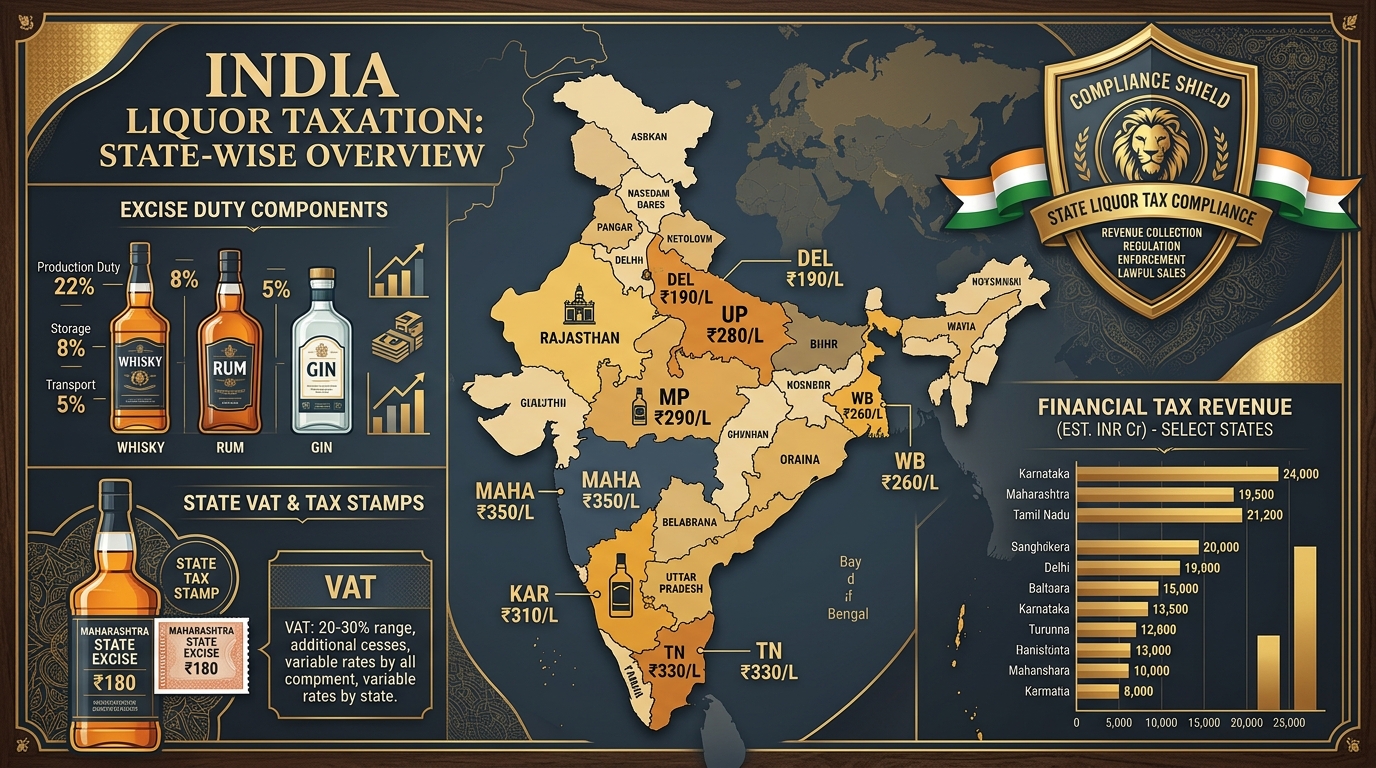
In India, there is no uniform national liquor tax. Unlike smartphones, clothing, or packaged groceries that fall under the unified Goods and Services Tax (GST), alcoholic liquor for human consumption is constitutionally excluded from GST.
Each of India's 28 states and 8 union territories operates its own autonomous excise department, setting independent duty rates, price bands, retail license fees, and sales taxes (VAT). Depending on the state border, taxes make up 50% to 75% of the final retail price of a bottle. Below is the complete, verified 2026–2027 state-by-state encyclopedia.
1. Why Alcoholic Liquor for Human Consumption is 100% Outside GST
When India implemented the historic Goods and Services Tax (GST) on 1 July 2017, thousands of central and state indirect levies—including Central Excise, Service Tax, State VAT, Entry Tax, and Luxury Tax—were subsumed under the single "One Nation, One Tax" umbrella. However, alcohol for human consumption was deliberately kept out. Here is the legal, economic, and constitutional rationale:
The 101st Constitutional Amendment Act 2016 specifically defined GST as: "any tax on supply of goods, or services or both, except taxes on the supply of the alcoholic liquor for human consumption." As a result, the GST Council does not have the constitutional jurisdiction to levy GST on potable alcohol.
Under the Seventh Schedule of the Constitution, Entry 51 of List II (State List) empowers state governments to levy State Excise Duties on alcoholic liquors, while Entry 54 of List II reserves the exclusive power for states to levy Value Added Tax (VAT) on its sale.
According to the Reserve Bank of India (RBI) State Finances Report, excise duty and VAT on alcohol contribute between 15% and 30% of individual states' Own Tax Revenue (SOTR). If alcohol were brought under GST, the maximum rate would be capped at 28% and shared 50:50 with the Centre, creating an immediate annual revenue deficit of over ₹1.5 Lakh Crore for state exchequers.
In October 2024, a landmark 9-judge Constitutional Bench of the Supreme Court of India ruled in State of UP vs. Lalta Prasad Vaish that states have regulatory control not just over potable liquor, but also over industrial denatured spirits to prevent unlawful diversion into illicit drinking alcohol.
Only potable alcohol for human consumption is outside GST. Industrial ethanol used for chemical manufacturing, pharmaceuticals, and the Government's 20% Ethanol Blended Petrol (E20) program attracts 5% or 18% GST with full Input Tax Credit (ITC) eligibility.
2. Interactive Alcohol Price & Tax Incidence Calculator
Select a beverage category and state to understand how manufacturing costs, state excise duty, wholesale distribution margins, and retail VAT compound into the final Maximum Retail Price (MRP).
Standard Indian Made Foreign Liquor blend of molasses spirit and imported grain/malt scotch.
3. Complete 36 States & Union Territories Liquor Tax Directory (2026–2027)
Search by state name or filter by geographical zone and availability to view statutory excise frameworks, retail VAT rates, special cesses, and legal drinking ages.
| State / UT | Status | Legal Age | Excise Framework | VAT / Sales Tax | Cess & Surcharges |
|---|---|---|---|---|---|
APAndhra Pradesh | Legal | 21 Years | Specific State Excise Duty + Variable Value Slabs APSBCL Government Monopoly | 60% - 70% on landed cost | Road Development Cess + Special Surcharge |
ARArunachal Pradesh | Legal | 21 Years | State Excise per London Proof Litre (LPL) Private Licensed Retailers | 20% - 22% | Border Security & Local Infrastructure Cess |
ASAssam | Legal | 21 Years | Ad-valorem slabs on Ex-Distillery Price (EDP) Private Licensed Vendors | 25% - 30% | Health & Education Development Cess |
BRBihar | Dry (Banned) | 21 Years | Zero Tax (Prohibited under Law) Total Statutory Prohibition | N/A (Prohibited) | Severe Penalties & Vehicle Confiscation |
CGChhattisgarh | Legal | 21 Years | State Excise Duty + Wholesale Margins State Corporation (CSMC) | 25% | Rural Development & Gau Seva Surcharge |
GAGoa | Legal | 18 Years | Lowest Specific Excise in India (₹20-₹60/BL) Private Licensed Retail & Taverns | 5% - 10% | Heritage Feni Promotion Fee |
GJGujarat | Permit Only | 21 Years | Exempt for domestic public; Special Duty on Permits Licensed Hotel Shops (Permit Only) | 65% on permit bottle sales | State Prohibition Monitoring Fund |
HRHaryana | Legal | 25 Years | Excise Policy 2025-27 Assessment Slabs E-Auction Quota Groups | 13.5% + Assessment Fee | Gau Samvardhan Cess (₹5/bottle) + Environment Cess |
HPHimachal Pradesh | Legal | 18 Years | State Excise per Proof Litre + Retail Markup Private Licensed Retailers | 14% - 16% | Milk Producer Cess (₹10/bottle) + Cow Welfare |
JHJharkhand | Legal | 21 Years | State Excise Duty + Maximum Retail Slabs JSBCL Government Managed Retail | 25% | Tribal Welfare Surcharge |
KAKarnataka | Legal | 21 Years | 2026 Alcohol-in-Beverage (AIB) Duty System KSBCL Wholesale Monopoly + Private Retail | 18.5% | Additional Excise Duty (AED) based on ABV |
KLKerala | Legal | 21 Years | Highest Sales Tax in India (Up to 247%) BEVCO 100% Retail Monopoly | 212% - 247% on IMFL; 120% - 175% on Low ABV | Kerala Social Security Cess + Medical Relief |
MPMadhya Pradesh | Legal | 21 Years | Specific Excise per Proof Litre + Stamp Duty Composite Liquor Outlets (Desi + Foreign) | 10% - 12% | Gau Sanrakshan Cess + Farmers Welfare Fund |
MHMaharashtra | Legal | 25 Years | 65% on Declared Manufacturing Cost or Floor Rate Private Licensed FL-II Outlets | 5% Retail / Standard Bar VAT | Drought Relief Surcharge + Transport Fee |
MNManipur | Permit Only | 21 Years | State Excise Policy 2024-2026 Regulated District HQs & Tourist Centers | 20% | Anti-Spurious Liquor Taskforce Fund |
MLMeghalaya | Legal | 21 Years | State Excise Duty Slabs on Bottle Size Private Licensed Retailers | 20% - 25% | Hill Area Road Maintenance Surcharge |
MZMizoram | Dry (Banned) | 21 Years | Zero Tax (Prohibited under Law) Total Prohibition (MLP Act 2019) | N/A (Prohibited) | Mandatory Penal Prosecution |
NLNagaland | Dry (Banned) | 21 Years | Zero Tax (Prohibited under Law) Total Prohibition (NLTP Act 1989) | N/A (Prohibited) | Strict Border Seizure Penalties |
ODOdisha | Legal | 21 Years | State Excise Duty + Landing Cost Markups OSBC Wholesale Monopoly + Private Retail | 25% | Cyclone & Disaster Infrastructure Surcharge |
PBPunjab | Legal | 25 Years | Excise Policy 2026-27 Minimum Price Bands Group Quota Auctions | 14% + Fixed Assessment Fee | Cow Cess (₹5/bottle) + Special Development Surcharge |
RJRajasthan | Legal | 18 Years | Specific State Excise Duty per Case RSBCL Wholesale + E-Auction Retail | 20% - 24% | Cow Protection Surcharge (20% on VAT amount) |
SKSikkim | Legal | 18 Years | Low State Excise Slabs per Bottle Private Licensed Retailers | 12.5% - 15% | Eco-Tourism & Clean Environment Fee |
TNTamil Nadu | Legal | 21 Years | Composite Excise Duty + State VAT Slabs TASMAC 100% State Monopoly | 58% - 62% Effective Combined Tax | Special Additional Excise Duty (SAED) |
TGTelangana | Legal | 21 Years | Ad-valorem Excise Duty on Basic Price TSBCL Wholesale + Lottery Retail Vends | 70% on landed wholesale price | Special Excise Cess + Welfare Surcharge |
TRTripura | Legal | 21 Years | State Excise Duty per Bottle Volume Private Licensed Retailers | 20% | Infrastructure Development Surcharge |
UPUttar Pradesh | Legal | 21 Years | UP Excise Policy 2026-27 Slabs & Composite Fee Private Licensed Vends via E-Lottery | Composite Consideration / License Structure | Gau Sanrakshan Upkar (Cow Cess ₹1-₹10) + 2D Track Fee |
UKUttarakhand | Legal | 21 Years | State Excise Duty + Transport Slabs Private Retail Auctions | 20% | Pilgrimage Zone & Forest Conservation Cess |
WBWest Bengal | Legal | 21 Years | Ad-Valorem Slabs based on Declared MRP WBSBCL Wholesale + Private Retail | 30% - 50% Effective Burden | State Education & Health Surcharge |
DLDelhi (NCT) | Legal | 25 Years | Delhi Excise Act 2009 Specific Duty Four Govt Corporations (DTTDC, DSIIDC, DCCWS, DSCSC) | 25% Delhi VAT (DVAT) | Air Quality & Urban Transport Fee |
CHChandigarh | Legal | 25 Years | Low Specific Excise Duty per Case Annual E-Auction Retail Vends | 12% - 15% | Cow Welfare Cess (₹5/bottle) |
PYPuducherry | Legal | 18 Years | Lowest South Indian Excise Duty Private Licensed Outlets & Bars | 10% - 12% | Coastal Tourism Development Cess |
DNDadra and Nagar Haveli and Daman and Diu | Legal | 21 Years | Nominal Excise Duty per Bulk Litre Private Licensed Retailers | 5% - 8% | Island Infrastructure Surcharge |
JKJammu and Kashmir | Legal | 21 Years | Excise Duty per London Proof Litre E-Auction Retail Licenses | 25% | Security & Rehabilitation Surcharge |
LALadakh | Legal | 21 Years | Specific Excise Duty per Case Regulated Licensed Outlets | 20% | High Altitude Environmental Fund |
LDLakshadweep | Dry (Banned) | 21 Years | Zero Tax (Prohibited on Inhabited Islands) Prohibited on Inhabited Islands; Bangaram Resort Bar Only | N/A | Strict Island Customs Quarantine |
ANAndaman and Nicobar Islands | Legal | 21 Years | Specific Excise + Island Freight Markup ANIIDCO Government Vends | 20% | Island Shipping Surcharge |
4. Dry States in India: Complete Prohibition & Permit Exceptions
Under Article 47 of the Directive Principles of State Policy in the Indian Constitution, the state shall endeavor to bring about prohibition of the consumption of intoxicating drinks except for medicinal purposes. Four states and one Union Territory enforce statutory alcohol bans:
Bihar (Total Prohibition)
Enacted under the Bihar Prohibition and Excise Act, 2016. Complete ban on the manufacture, trade, storage, transit, sale, and consumption of all alcoholic beverages. Vehicles transporting liquor are seized and auctioned, premises sealed, and breathalyzer checkpoints operate statewide. While minor amendments in 2022 allowed first-time consumers to pay a court penalty (₹2,000–₹5,000) instead of mandatory jail, repeat offenses carry rigorous imprisonment.
Gujarat (Prohibition with Tourist Permits)
Governed under the Bombay Prohibition (Gujarat Amendment) Act, 1949. While strictly dry for permanent state residents, non-resident domestic tourists, foreign nationals, and long-term health permit holders can apply for legal permits online or at approved star hotel wine shops. In 2024, the government permitted on-premise consumption within the GIFT City (Gujarat International Finance Tec-City) for registered financial workforce members.
Nagaland (NLTP Act 1989)
The Nagaland Liquor Total Prohibition (NLTP) Act was enacted in 1989 following persistent civil and church movements. Possession and consumption are banned across the state. However, the state legislative assembly is presently conducting consultative reviews regarding partial lifting in designated tourist zones to curb revenue flight to neighboring Assam.
Mizoram (MLP Act 2019)
After experimenting with a regulated liquor market between 2015 and 2019, the newly elected government passed the Mizoram Liquor (Prohibition) Act in 2019, re-imposing total prohibition across the state. Exceptions are limited strictly to armed forces canteens and verified medical emergency prescriptions.
Lakshadweep Union Territory (Bangaram Island Exception)
All inhabited islands of Lakshadweep (such as Kavaratti, Agatti, Amini, Andrott, and Minicoy) maintain 100% total alcohol prohibition respecting local indigenous traditions. The only exception across the entire archipelago is the uninhabited resort island of Bangaram, where an authorized government bar operates exclusively for non-Muslim domestic and international tourists.
5. Legal Drinking Age in India: The 18 vs 21 vs 25 Paradox
Because state excise acts govern alcohol rather than federal statutes, the legal minimum age to purchase or consume alcohol varies significantly when crossing state borders.
States that align the drinking age with the age of majority (18 years) to boost tourism, hospitality, and student recreation:
- Goa
- Sikkim
- Himachal Pradesh
- Rajasthan
- Puducherry (UT)
The most prevalent benchmark adopted across central, southern, and eastern India:
- Karnataka & Tamil Nadu
- Uttar Pradesh & Uttarakhand
- Kerala & Andhra Pradesh
- West Bengal, Odisha & Assam
- Madhya Pradesh & Telangana
- Maharashtra (For Mild Beer/Wine Only)
States enforcing the highest minimum drinking age in the world under legacy colonial excise codes:
- Delhi (NCT)
- Haryana
- Punjab
- Chandigarh (UT)
- Maharashtra (For Hard Spirits/IMFL)
6. Types of Liquor in India & Market Share Breakdown
What does India actually drink? The Indian alcoholic beverage market is sharply segmented into statutory classifications, each bearing distinct tax burdens, manufacturing requirements, and consumer demand curves.
India is the largest whisky consumer in the world by volume. Most Indian whisky is made from molasses-based Extra Neutral Alcohol (ENA) blended with imported malt. Leading volume drivers include McDowell's No.1, Royal Stag, Officer's Choice, and Blender's Pride.
Dominates military CSD canteens, winter seasonal consumption, and the eastern/coastal states. The iconic dark rum Old Monk, along with McDowell's Celebration Rum, represents the bulk of consumption.
Highly localized: >90% of all brandy consumed in India is in South India (Tamil Nadu, Kerala, Andhra Pradesh, and Telangana). In Tamil Nadu's TASMAC shops, brandy frequently outsells whisky.
India has a unique global preference: over 85% of total beer volume sold is Strong Beer (ABV 5.5% to 8.0%) such as Kingfisher Strong, Carlsberg Elephant, and Tuborg Strong, rather than mild lagers.
Low-cost local distilled spirits including Mahua (Central India), Cashew & Coconut Feni (Goa - GI tagged), Arrack, Toddy (South India), and Chhang (Himalayas). Strictly tracked with holographic seals to prevent lethal methanol poisoning.
Indian craft gins (Greater Than, Stranger & Sons, Hapusa) and domestic wines from Nashik (Sula, Fratelli) represent under 5% of total volume but are expanding rapidly among urban millennial and female demographics.
7. Karnataka's Landmark 2026 AIB (Alcohol-in-Beverage) Excise Reform
On 11 May 2026, the Government of Karnataka implemented one of the most radical indirect tax restructurings in the history of Indian liquor policy. Previously, Karnataka calculated state excise duty using a rigid matrix of 16 declared price slabs. This created massive price distortions, encouraging adulteration and making premium imported spirits astronomically expensive compared to neighboring Goa.
How the AIB Mechanism Operates:
Excise duty was pegged strictly to declared ex-distillery invoice prices. Crossing a price threshold by just ₹10 pushed an entire case into a significantly higher tax bracket, causing brands to compress margins or artificially depress declared values.
Tax incidence is directly linked to the quantity of pure ethanol contained in the bottle. Beverages with lower alcohol content (such as mild beer and table wines) enjoy lower specific duties, while high-proof spirits pay an equitable duty based on pure alcohol volume.
Market Impact: Premium and bottled-in-origin (BIO) Scotch whiskies witnessed retail price reductions of ₹500 to ₹1,800 per bottle in Bengaluru, sharply curbing unauthorized border smuggling from Goa and Haryana.
8. Educational Video Masterclass: Alcohol Taxation & Policy in India
Watch curated video case studies and constitutional explainers from leading business analysts covering excise arbitrage, state revenue dependency, and liquor store compliance.
How BroCode Navigated India's Alcohol Tax Structure: Business Case Study
Deep-dive case study analyzing how BroCode's founder navigated India's complex alcohol taxation framework by leveraging differences between beer and wine excise categories to build a multi-crore brand.
Understanding category classifications (Wine vs Beer vs IMFL) and proof-litre thresholds can create massive commercial advantages in state excise compliance.
Why Craft Beer Brands Face Challenges in India: The Multi-State Tax Hurdle
Comprehensive breakdown of the structural, logistical, and licensing challenges craft beer makers encounter when expanding across individual Indian states with fragmented excise policies.
Because alcohol is outside GST, brands cannot simply ship across state borders; each state requires separate label registration, warehouse licenses, and import-export permits.
Exploring India's Alcohol Market: State Regulations, Taxes and Licenses
Detailed legal analysis examining state government distribution monopolies (TASMAC in Tamil Nadu, BEVCO in Kerala, WBSBCL in West Bengal) versus private auction systems.
States control every step of the supply chain—from distillery bottling fees to wholesale margins and consumer retail prices—to maximize revenue extraction.
Why Alcohol Is Kept Out of GST? Indian State Excise & Article 366 Explained
Authoritative constitutional explainer on why the 101st Constitutional Amendment specifically excluded alcoholic liquor for human consumption from the GST Council's jurisdiction.
Bringing alcohol under GST would require a two-thirds majority in Parliament plus ratification by 50% of state legislatures, which state finance ministries strongly oppose.
No GST On Alcohol & Liquor: Why Wine Shops Pay State Excise & VAT Instead
Practical tutorial for liquor retailers, bar operators, and hoteliers on managing dual tax accounts—filing state VAT returns for liquor while filing GSTR-3B for food supplies.
Liquor retailers cannot claim Input Tax Credit (ITC) on commercial rent, transport, or advertising GST because their outward supply of liquor is exempt from GST.
Why States Depend on Alcohol Revenue: Fiscal Federalism & 20%+ State Budget Share
Macroeconomic analysis evaluating how state budgets in Uttar Pradesh, Karnataka, Tamil Nadu, and Maharashtra rely on liquor taxes to fund welfare schemes, roads, and healthcare.
Alcohol excise and petroleum VAT are the only two major fiscal levers left with Indian state governments following the centralization of general indirect taxes under GST.
9. Restaurant & Bar Billing: Managing 5% GST on Food vs State VAT on Alcohol
One of the most complex operational hurdles in the Indian food & beverage (F&B) sector is handling composite orders. When a customer orders food along with cocktails or beer at a licensed restro-bar, how is tax applied?
- • Standard standalone restaurants: 5% GST (2.5% CGST + 2.5% SGST)
- • Star hotels (room tariff > ₹7,500/night): 18% GST with full ITC
- • Must be reported in monthly GSTR-1 (Table 7 / 11) and GSTR-3B
- • Beer, wine, cocktails, shots: State VAT (10% to 25% depending on state)
- • Zero GST is levied on the liquor portion of the bill
- • Must be reported in state excise/VAT department monthly return
GST Munshi’s intelligent cloud POS automatically splits every order ticket (KOT): calculating 5% GST on kitchen items while applying precise state VAT rates on bar counter items in a single print-ready receipt. At month-end, export statutory GSTR-1 files for food and state VAT audit summaries for excise compliance with one click.
Recommended Video Tutorials & Practical Walkthroughs
Watch these handpicked, expert video guides covering practical compliance, step-by-step procedures, and real-world implementation:
Recommended Video Tutorials & Practical Guides
10. FAQs on Liquor Taxes & Alcohol Laws in India
Can an individual carry liquor from Goa or Haryana to Delhi or Mumbai?
Generally, interstate transit of liquor without a permit issued by the destination state's excise department is illegal. While Goa permits tourists to carry up to 2 bottles with an official ₹20 excise transit permit, entering states like Maharashtra or Karnataka with Goa liquor is strictly prohibited under local excise acts and can lead to confiscation, vehicle impounding, and criminal prosecution. Delhi strictly prohibits bringing more than 1 liter of duty-paid liquor from neighboring states.
Can liquor shops or bars claim Input Tax Credit (ITC) on commercial rent or electricity?
No. Under Section 17(2) of the CGST Act, Input Tax Credit is restricted when inputs or input services are used for making exempt supplies. Because alcoholic liquor for human consumption is an exempt/non-taxable supply under GST, liquor retailers cannot claim ITC on shop rent, logistics, insurance, or renovation GST.
Why are liquor prices significantly cheaper in Goa compared to Karnataka or Kerala?
Goa deliberately levies nominal specific excise duties (₹20 to ₹60 per bulk litre) and low VAT to stimulate hospitality, night-markets, and coastal tourism. In contrast, Kerala levies up to 247% sales tax through BEVCO, and Karnataka levies high AIB specific duties and AED to generate over ₹35,000 Crore for state welfare commitments.
What is the Cow Welfare Cess on liquor in Uttar Pradesh and Rajasthan?
Several northern states levy dedicated surcharges on liquor bottles to fund stray cattle shelters (Gaushalas) and bovine healthcare. Uttar Pradesh imposes the Gau Sanrakshan Upkar (ranging from ₹1 on beer to ₹10 on premium IMFL), while Rajasthan imposes a 20% surcharge on the VAT component of alcohol sales.
Will liquor ever be brought under GST in India?
It is highly unlikely in the near future. Amending Article 366(12A) requires a constitutional amendment passed by a two-thirds special majority in both Houses of Parliament, plus ratification by more than 50% of all state legislative assemblies. Since alcohol excise is one of the few remaining sovereign revenue streams directly controlled by state finance ministers, there is currently no political or fiscal consensus among states to surrender it to the GST Council.
State excise duties, brand registration fees, wholesale margins, and retail VAT percentages are revised periodically by respective state excise departments through annual excise policies and official state gazettes. While the data above reflects verified 2026–2027 statutory notifications, business owners, distilleries, and retail vendors should verify active excise schedules with their local district excise officer before undertaking commercial operations.