
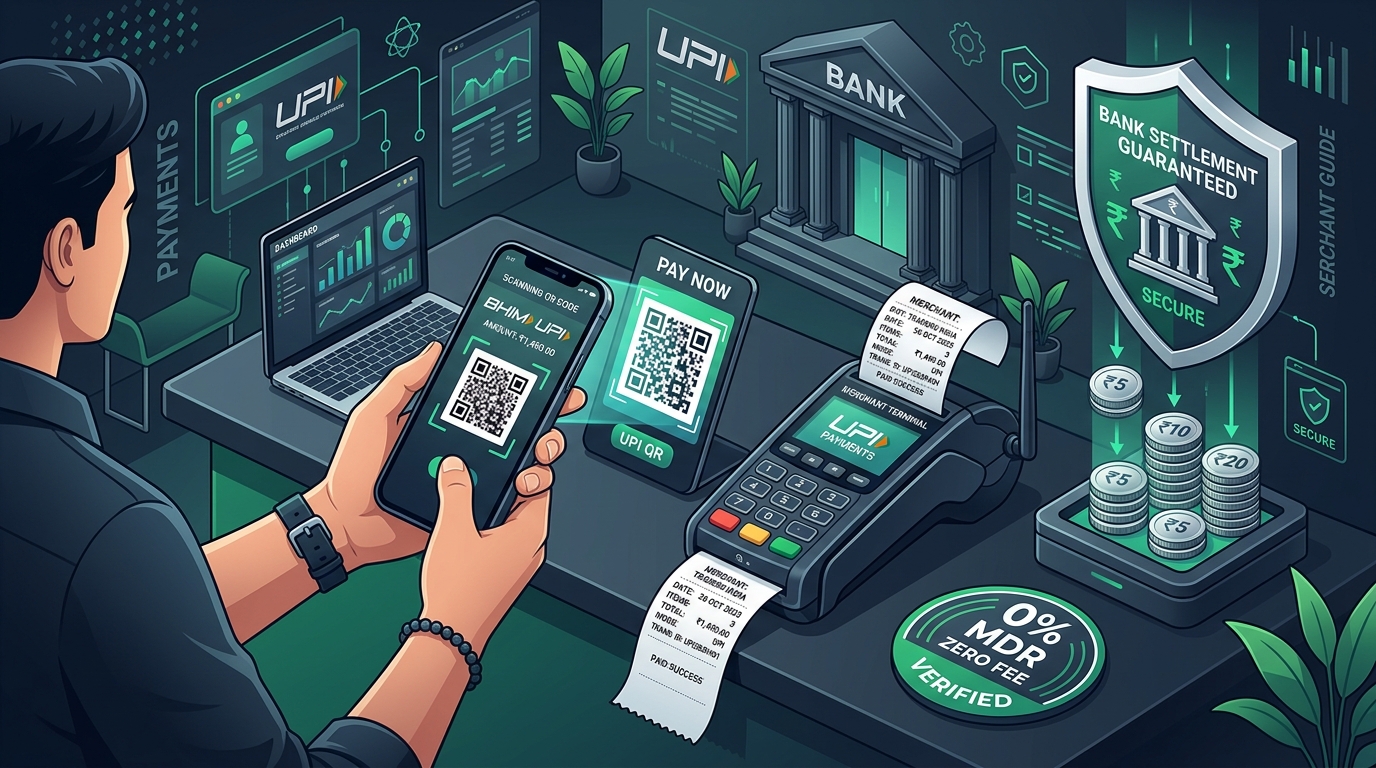
1. Quick Overview & 2026 Digital Payment Highlights
India's Unified Payments Interface (UPI) processes over 16 billion transactions monthly. For kirana retailers, wholesalers, service providers, and startups, UPI is the lifeblood of daily cash flow. However, confusion persists regarding transfer ceilings, interchange fees, and potential tax notices.
Direct Bank-to-Bank UPI remains legally zero-cost for merchants.
Applicable for taxes, hospitals, educational fees, and capital markets.
Unregistered commercial UPI turnover triggers automated GST alerts.
UPI Merchant Fee & GST Impact Calculator
Input your estimated monthly digital payment turnover to calculate the difference between direct bank UPI payments, prepaid wallet transactions, and traditional card payment gateways:
Standard QR scans from Google Pay, PhonePe, Paytm linked directly to customer bank accounts.
Payments initiated specifically from prepaid wallets (not direct bank accounts) above ₹2,000.
2. Bank-Wise Daily UPI Limits in 2026
While the National Payments Corporation of India (NPCI) has set an upper limit of ₹1,00,000 per day for standard P2P payments and ₹5,00,000 per day for capital markets, taxes, and medical expenses, individual partner banks enforce distinct internal risk limits:
| Bank Name | Max Per Transaction | Max Daily Ceiling | Max Daily Count | Special Categories (Tax/Hospital) |
|---|---|---|---|---|
| State Bank of India (SBI) | ₹1,00,000 | ₹1,00,000 | 10 Transactions | Up to ₹5,00,000 |
| HDFC Bank | ₹1,00,000 | ₹1,00,000 | 20 Transactions | Up to ₹5,00,000 |
| ICICI Bank | ₹1,00,000 | ₹1,00,000 | 10 Transactions | Up to ₹5,00,000 |
| Punjab National Bank (PNB) | ₹25,000 – ₹50,000 | ₹50,000 | 10 Transactions | Up to ₹2,00,000 |
| Axis Bank | ₹1,00,000 | ₹1,00,000 | 20 Transactions | Up to ₹5,00,000 |
| Bank of Baroda (BoB) | ₹25,000 | ₹50,000 | 10 Transactions | Up to ₹5,00,000 |
*Note: For newly created UPI IDs or newly linked bank accounts, most banks enforce a statutory 24-hour cooling ceiling of ₹5,000 to prevent unauthorized fraud.
Print Invoices with Dynamic UPI QR & Real-Time Payment Links
Stop asking customers to enter amounts manually. GST Munshi generates custom dynamic QR codes on thermal slips and WhatsApp invoices with the exact bill total pre-filled.
3. UPI Charges Demystified: Zero MDR vs 1.1% Wallet Interchange
Every few months, sensational headlines proclaim that "UPI payments will now be charged 1.1%". Let us separate statutory fact from social media rumors:
Under Section 10A of the Payment and Settlement Systems Act 2007, no bank or payment service provider can levy any Merchant Discount Rate (MDR) on payments made via UPI or RuPay debit cards. Whether a customer pays ₹10 or ₹1,00,000 from their bank account, the merchant receives 100% of the funds without any deductions.
Per NPCI circulars, the interchange fee (ranging between 0.5% and 1.1%) is applied only when a customer uses a prepaid wallet (such as Paytm Wallet, Sodexo, or Amazon Pay balance) to scan an interoperable merchant QR for amounts exceeding ₹2,000. It compensates the wallet issuer for loading costs and does not apply to normal bank transfers.
Over 99.7% of customer payments in Indian retail are direct bank-to-bank UPI transfers. Therefore, the effective transaction processing cost for small merchants across India remains practically 0%.
4. Income Tax & GST Scrutiny on UPI Collections (Section 133(6))
The biggest risk facing Indian shopkeepers in 2026 is not transaction fees, but statutory non-compliance. Because UPI transactions leave an immutable digital trail, tax authorities use automated artificial intelligence engines to cross-examine digital receipts against filed returns:
1. GST Threshold Breach Without Registration
If your cumulative annual business receipts (cash + UPI) exceed ₹40 Lakhs for goods (or ₹20 Lakhs for services/special category states), GST registration is mandatory under Section 22 of the CGST Act. The GST department receives banking transaction data through the Directorate General of Analytics and Risk Management (DGARM). Collecting ₹50 Lakhs via UPI without a GSTIN triggers immediate tax demand notices with 100% penalties under Section 73/74.
2. Mismatch Between Annual Information Statement (AIS) and ITR Turnover
Under Section 285BA of the Income Tax Act, banks report high-value digital receipts to the tax portal under Statement of Financial Transactions (SFT). If your bank account records ₹45 Lakhs in UPI deposits, but your ITR-4 (Presumptive Scheme under Section 44AD) reports gross turnover of only ₹20 Lakhs, the Centralized Processing Centre (CPC) issues a computerized inquiry under Section 133(6) requiring itemized reconciliation of the ₹25 Lakh discrepancy.
3. Unexplained Cash Credits (Section 68 Penalty)
If you receive large UPI transfers and cannot provide matching sales invoices, estimates, or customer contracts, the Assessing Officer (AO) has statutory power to treat these receipts as Unexplained Cash Credits under Section 68. Such sums are taxed at a punitive flat rate of 78% (60% basic tax + 25% surcharge + 4% cess under Section 115BBE) with zero expense deductions permitted.
5. Five Best Practices for Small Business Digital Compliance
To protect your business from unnecessary scrutiny while taking full advantage of zero-MDR UPI payments, implement these five golden rules:
Segregate Personal & Business Accounts
Never use your personal savings bank account for store QR collections. Open a dedicated Current Account in your trade name linked directly to your GSTIN.
Issue an Invoice for Every UPI Payment
Never accept payments without generating a matching sales bill. Use an automated tool like GST Munshi to produce instantaneous thermal slips or WhatsApp receipts for every transaction.
Opt for Section 44AD Presumptive Taxation
For digital turnovers up to ₹3 Crores, small businesses can declare minimum presumptive profit at just 6% (compared to 8% for cash sales), substantially lowering tax obligations.
Reconcile Monthly GSTR-1 with Bank Receipts
Ensure that your total sales reported in Table 4 (B2B) and Table 7 (B2C Small) of GSTR-1 closely match the total digital credits received in your bank statement.
Recommended Video Tutorials & Practical Walkthroughs
Watch these handpicked, expert video guides covering practical compliance, step-by-step procedures, and real-world implementation:
Recommended Video Tutorials & Practical Guides


Frequently Asked Questions (FAQs)
Are customers or merchants charged any fee for regular UPI transactions in 2026?▸
No. Regular bank-account-to-bank-account UPI payments (both Person-to-Person P2P and Person-to-Merchant P2M) carry strictly 0% Merchant Discount Rate (Zero MDR). Under Section 10A of the Payment and Settlement Systems Act 2007, banks and payment aggregators cannot levy any transaction fee or MDR on account-to-account UPI or RuPay debit cards.
What is the 1.1% UPI interchange fee, and who pays it?▸
The 1.1% interchange fee applies exclusively to Prepaid Payment Instruments (PPI Wallets like Paytm Wallet, Amazon Pay, or Mobikwik) for merchant transactions exceeding ₹2,000. It is paid by the payment aggregator/merchant's acquiring bank to the wallet issuer. Normal bank-to-bank UPI transfers have zero interchange.
Does high UPI transaction volume attract GST or Income Tax notices?▸
Yes. Every UPI transaction is settled directly through banking channels and reported via the Annual Information Statement (AIS) and Statement of Financial Transactions (SFT). If your annual UPI receipts exceed the GST threshold (₹20 Lakh for services or ₹40 Lakh for goods) without GST registration, or if business deposits exceed declared ITR turnover, tax algorithms automatically flag accounts for scrutiny under Section 133(6) of the Income Tax Act.
What is the daily maximum UPI transfer limit in 2026?▸
NPCI specifies a standard daily limit of ₹1,00,000 for peer-to-peer transfers, with enhanced limits up to ₹5,00,000 for verified capital market investments, insurance, educational institutions, hospital healthcare payments, and government tax deposits. Individual banks enforce bank-specific daily ceilings between ₹25,000 and ₹1,00,000.
Should small shopkeepers use a personal savings account QR or a Current Account QR?▸
Retailers and service providers should always use a designated Current Account linked to their business GSTIN. Using a personal savings account for high-frequency business UPI collections violates RBI banking guidelines, triggers savings bank cash/digital deposit red flags, and complicates tax audits by mixing personal transfers with business revenue.