

When does Daylight Saving Time start and end in 2027, and which way do the clocks move?
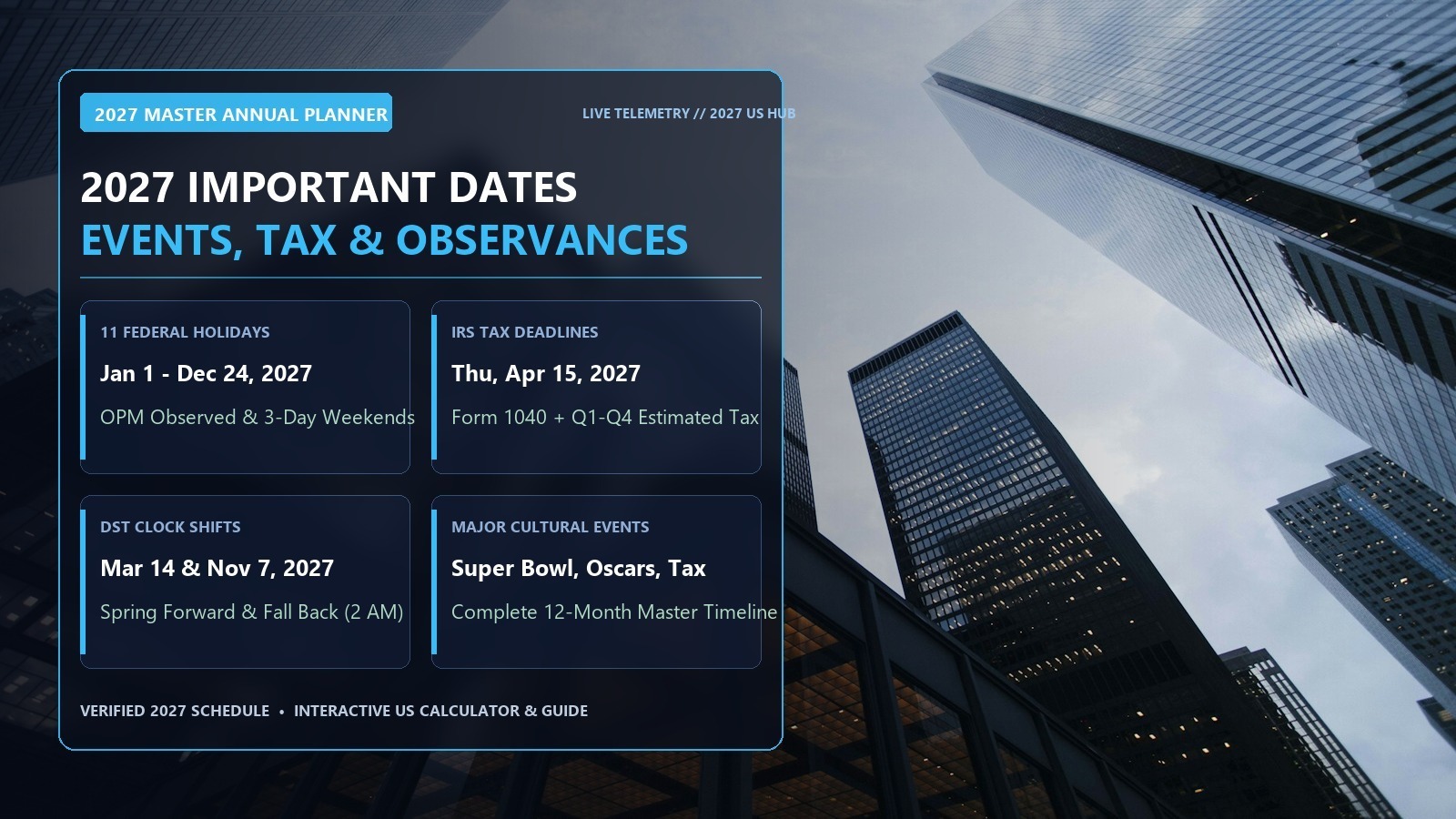
In 2027, Daylight Saving Time (DST) in the United States starts on Sunday, March 14, 2027 at 2:00 AM local time, when clocks 'spring forward' one hour to 3:00 AM (making it a 23-hour day and losing one hour of sleep). Daylight Saving Time ends on Sunday, November 7, 2027 at 2:00 AM local time, when clocks 'fall back' one hour to 1:00 AM (making it a 25-hour day and gaining one hour of sleep). Regulated under 15 U.S.C. § 260a, DST lasts exactly 238 days (34 weeks) across all states except Hawaii, most of Arizona, and five U.S. territories.
2027 Daylight Saving Time (DST) Master Simulator & Wage Auditor
Audited against 15 U.S.C. § 260a, Energy Policy Act of 2005 & FLSA 29 CFR § 785.11
1Exact 2027 Daylight Saving Time Start & End Dates (15 U.S.C. § 260a)
Under the federal Uniform Time Act of 1966 as amended by Section 110 of the Energy Policy Act of 2005 (codified at 15 U.S.C. § 260a), Daylight Saving Time in the United States begins at 2:00 AM on the second Sunday of March and concludes at 2:00 AM on the first Sunday of November. The U.S. Department of Transportation (DOT) exercises statutory oversight across all nine official American time zones to guarantee administrative uniformity for commercial airlines, interstate rail, financial wire clearing, and telecommunications.
In calendar year 2027, the nationwide spring changeover takes place on Sunday, March 14, 2027. At exactly 2:00:00 AM local standard time, automated smart clocks, cell towers, and utility load controllers jump forward by sixty minutes to 3:00:00 AM local daylight time. Because the entire 2:00 AM to 2:59:59 AM hour is legally bypassed, March 14, 2027, is a 23-hour calendar day. Americans lose one hour of overnight sleep, and sunset shifts approximately one hour later in the evening.
The autumn reversal takes place on Sunday, November 7, 2027. At exactly 2:00:00 AM local daylight time, clocks fall back sixty minutes to 1:00:00 AM local standard time. The 60-minute interval from 1:00:00 AM to 1:59:59 AM repeats twice consecutively, producing a 25-hour calendar day. Citizens regain one hour of overnight sleep, sunrise arrives one hour earlier in the morning, and twilight falls earlier in the late afternoon.
- Sunday, March 14, 2027 (2:00 AM → 3:00 AM): Eastern Standard Time (EST) transitions to Eastern Daylight Time (EDT, UTC-4), CST becomes CDT (UTC-5), MST becomes MDT (UTC-6), and PST becomes PDT (UTC-7).
- Sunday, November 7, 2027 (2:00 AM → 1:00 AM): EDT returns to EST (UTC-5), CDT returns to CST (UTC-6), MDT returns to MST (UTC-7), and PDT returns to PST (UTC-8).
- Why 2:00 AM Was Chosen by Regulators: Under 49 CFR Part 71, the 2:00 AM Sunday switch time minimizes logistical disruption because passenger train movement, long-distance freight, bank batch reconciliation, and airline arrivals are at their weekly lowest volume, while hospitality venues have largely closed.
- Net 2027 Duration: The United States remains on Daylight Saving Time for 238 days (34 weeks), meaning the nation spends 65.2% of 2027 on daylight time and only 127 days (34.8%) on standard winter time.
2Which US States & Territories Do Not Observe Daylight Saving Time in 2027?
Under Section 3(a) of the Uniform Time Act (15 U.S.C. § 260a(a)), individual states retain the legal authority to exempt their entire jurisdiction—or that portion of a state lying entirely within a single time zone—from Daylight Saving Time by passing an explicit state statute. However, federal law strictly prohibits states from unilaterally adopting permanent year-round Daylight Saving Time without an Act of Congress.
Currently, two states—Hawaii and Arizona—along with all five permanently inhabited U.S. territories remain on year-round Standard Time throughout 2027. Hawaii enacted its exemption in 1967 (Hawaii Revised Statutes § 1-31) because its tropical latitude near 21° North experiences minimal variation in sunrise and sunset between summer and winter. Arizona opted out in 1968 (Arizona Revised Statutes § 1-242) to protect residents from blistering desert heat: extending daylight until 9:00 PM would increase residential cooling loads and air conditioning power consumption during peak 105°F+ summer evenings.
A celebrated geographic anomaly exists within northeastern Arizona. The Navajo Nation—whose reservation spans 27,000 square miles across northeastern Arizona, northwestern New Mexico, and southeastern Utah—exercises tribal sovereignty and observes Daylight Saving Time (Mountain Daylight Time, MDT, UTC-6) to keep schools, police, and administration synchronized across state lines. Conversely, the Hopi Reservation, which forms a geographic enclave entirely surrounded by the Navajo Nation, follows Arizona state policy and does not observe DST. Motorists driving along Arizona State Route 264 cross through alternating time zones multiple times within a two-hour journey.
- Hawaii (HST — UTC-10 Year-Round): Fully exempt under state statute; Hawaiian clocks never advance or retreat.
- Arizona Majority (MST — UTC-7 Year-Round): Phoenix, Tucson, Flagstaff, Mesa, and the Hopi Reservation remain on Mountain Standard Time all year.
- Navajo Nation (MDT — UTC-6 in Summer): Observes Daylight Saving Time from March 14 to November 7, 2027, creating a one-hour difference with surrounding Arizona towns.
- U.S. Territories on Permanent Standard Time: Puerto Rico and U.S. Virgin Islands (Atlantic Standard Time, AST, UTC-4), American Samoa (Samoa Standard Time, SST, UTC-11), Guam and Northern Mariana Islands (Chamorro Standard Time, ChST, UTC+10).
3Sunshine Protection Act Status & The 1974 Nixon Winter Experiment Failure
Over the past decade, public frustration with the disruptive biannual clock shift led state legislatures in over twenty states—including Florida, California, Texas, Washington, Oregon, Tennessee, and Georgia—to pass trigger laws or ballot measures endorsing permanent Daylight Saving Time. These state measures cannot take legal effect until the U.S. Congress amends 15 U.S.C. § 260a to permit permanent year-round DST.
The federal Sunshine Protection Act (sponsored by Florida Senators Marco Rubio and Rick Scott) passed the U.S. Senate by unanimous consent in March 2022, and a reintroduced version (H.R. 139) passed the House in the 119th Congress. However, the legislation has repeatedly stalled in the Senate due to sharp scientific division between retail trade associations and medical authorities. Commercial lobbies—including retail chains, the golf industry, and convenience store operators—strongly favor permanent DST because longer evening daylight hours boost consumer shopping, outdoor sports, and retail spending.
Conversely, medical organizations led by the American Academy of Sleep Medicine (AASM), the American Medical Association (AMA), and the National Sleep Foundation adamantly oppose permanent DST, advocating instead for permanent Standard Time. Sleep scientists warn that permanent DST forces sunrises past 8:30 AM across northern and western time zone borders during winter months, causing chronic circadian misalignment, adolescent sleep deprivation, and higher seasonal depression.
Lawmakers frequently point to historical precedent: the United States already attempted year-round Daylight Saving Time in 1974 with disastrous results. On December 15, 1973, President Richard Nixon signed the Emergency Daylight Saving Time Energy Conservation Act (Pub. L. 93-182) during the OPEC oil crisis, putting the country on year-round DST starting January 6, 1974. Although initial public approval registered at 79%, support collapsed to 42% within three months. Millions of children were forced to walk to school and wait for buses in freezing pitch darkness, resulting in several fatal traffic accidents involving schoolchildren in Florida and Virginia. After Department of Transportation studies revealed that national electricity savings were negligible (approximately 0.03%), Congress repealed the winter mandate in October 1974, and President Gerald Ford returned the nation to standard winter time.
- Why States Cannot Adopt Year-Round DST Alone: Federal statute 15 U.S.C. § 260a permits states to opt out of DST, but explicitly forbids states from opting out of Standard Time without federal statutory change.
- Commercial Lobby vs. Medical Consensus: Business groups favor permanent DST for late evening retail sales, whereas sleep medicine physicians demand permanent Standard Time to align circadian biology with morning sunrise.
- The 1974 Nixon Lesson: Year-round DST was enacted in January 1974 and swiftly repealed by October 1974 after winter morning darkness triggered schoolchild fatalities and widespread public revolt.
- 2027 Legislative Reality: Because Congress has not enacted the Sunshine Protection Act into public law, the standard biannual clock adjustment remains legally mandatory for 2027.
4Overnight Graveyard Shift Pay Laws (FLSA 29 CFR § 785.11 & State Overtime)
For millions of American healthcare professionals, emergency first responders, warehouse logistics personnel, and factory workers on duty during the 2:00 AM changeover, time changes carry immediate payroll and statutory wage consequences under the Fair Labor Standards Act (FLSA, 29 U.S.C. § 207) administered by the U.S. Department of Labor (DOL) Wage and Hour Division.
Under federal wage law (29 CFR § 785.11), employers are required to compensate non-exempt hourly employees for all hours actually worked. On Sunday, March 14, 2027, an employee scheduled for an 8-hour shift from 11:00 PM to 7:00 AM physically works only 7 hours because the clock leaps from 2:00 AM directly to 3:00 AM. Under FLSA regulations, the employer is legally obligated to pay for only the 7 actual hours worked, though many collective bargaining agreements and employer policies pay the scheduled 8 hours as an employee benefit.
Conversely, on Sunday, November 7, 2027, an employee scheduled for the identical 11:00 PM to 7:00 AM shift physically works 9 hours because the 1:00 AM to 2:00 AM hour repeats. Under federal law, the employer must pay the worker for all 9 physical hours worked. Furthermore, if that 9th hour causes the employee's weekly total to exceed 40 hours, the employer must pay statutory overtime at time-and-a-half (1.5 times the regular hourly rate). In states with daily overtime statutes—such as California (California Labor Code § 510), Alaska, Nevada, and Colorado—working 9 hours in a single workday automatically triggers daily overtime for the 9th hour regardless of weekly totals.
- March 14 'Spring Forward' Payroll Rule: Non-exempt graveyard workers work 7 physical hours on an 8-hour schedule; employers are legally required to pay for 7 hours under federal rules.
- November 7 'Fall Back' Payroll Rule: Non-exempt workers physically work 9 hours; employers must pay for all 9 hours, including weekly or daily overtime where applicable.
- Union & Collective Bargaining Clauses: Unionized hospital and police personnel should review their contract language, as many master agreements stipulate 8 hours of pay in March while retaining 9 hours with premium overtime in November.
- Automated Time-Clock Configuration: Corporate HR controllers must verify that electronic biometric punch clocks track elapsed physical minutes rather than wall-clock timestamps to avoid wage underpayment lawsuits.
52027 US vs. UK/Europe Mismatch Gaps & Transatlantic Stock Market Hours
International institutional investors, corporate treasurers, currency traders, and transatlantic remote engineering teams face a recurring operational hazard every spring and autumn: the United States and Europe adjust their clocks on different calendar Sundays, creating multi-week synchronization gaps.
While the United States initiates Daylight Saving Time on the second Sunday of March (March 14, 2027) and concludes on the first Sunday of November (November 7, 2027), the United Kingdom (British Summer Time, BST) and the European Union (Central European Summer Time, CEST, governed by EU Directive 2000/84/EC) always make their transitions on the last Sunday of March (March 28, 2027) and the last Sunday of October (October 31, 2027).
This divergence produces two distinct annual mismatch windows in 2027: a 14-day spring gap from March 14 to March 28, and a 7-day autumn gap from October 31 to November 7. During these intervals, the standard 5-hour time difference between New York (Eastern Time) and London contracts to 4 hours, while the difference with Frankfurt and Paris drops from 6 hours to 5 hours. As a result, the New York Stock Exchange (NYSE) and Nasdaq opening bell (9:30 AM EDT) rings at 1:30 PM London / 2:30 PM Frankfurt instead of the customary 2:30 PM London / 3:30 PM Frankfurt, adding sixty minutes of high-volume cross-border trading overlap.
- Spring 2027 Transatlantic Gap (March 14 – March 28): For two full weeks, New York is 4 hours behind London instead of 5, shifting corporate call schedules and currency fixings.
- Autumn 2027 Transatlantic Gap (October 31 – November 7): For one week, Europe has returned to standard time while the U.S. remains on daylight time, again shrinking the transatlantic gap to 4 hours.
- Wall Street Trading Shift for Asian Markets: Because financial centers like Tokyo (JST, UTC+9), Hong Kong (HKT, UTC+8), and Mumbai (IST, UTC+5:30) never observe DST, NYSE trading hours (9:30 AM – 4:00 PM ET) shift one hour earlier in local evening times across Asia from March 14 to November 7, 2027.
- Fedwire & CHAPS Clearing Deadlines: Cross-border treasury departments executing same-day dollar/euro currency swaps must adjust wire cutoffs by one hour during both mismatch intervals.
6Circadian Health Hazards (24% Heart Attack Surge, 6% Car Crashes) & Home Fire Safety
Mounting clinical evidence demonstrates that the sudden loss of sixty minutes of sleep during the spring transition imposes severe physiological stress on the human cardiovascular and neurological systems. The human body's central circadian pacemaker—the suprachiasmatic nucleus (SCN) in the hypothalamus—relies on morning natural light to regulate cortisol secretion, blood pressure, and core body temperature.
Epidemiological studies published in leading medical journals document alarming public health spikes during the workweek following the spring time change. A landmark study published in Open Heart by researchers from the University of Michigan and the American Heart Association revealed a 24% surge in acute myocardial infarction (heart attack) hospital admissions on the Monday immediately following Spring Forward. Conversely, the autumn Fall Back shift is associated with a 21% reduction in heart attack admissions on the Tuesday following the extra hour of rest. Furthermore, research in the American Academy of Neurology indicates an 8% increase in ischemic strokes during the first 48 hours following the spring changeover.
Transportation safety is equally compromised. A 20-year empirical study conducted by researchers at the University of Colorado Boulder and published in Current Biology demonstrated a 6% spike in fatal motor vehicle crashes throughout the entire workweek following the spring clock shift, accounting for roughly 28 excess traffic fatalities each year in the United States. The fatal crash surge concentrates heavily during early morning commutes when drivers suffer from acute sleep deficit and darker morning road conditions.
To mitigate these physiological risks, chronobiologists recommend a 4-day phase-advance protocol beginning on Wednesday, March 10, 2027: shift your bedtime and waking alarm 15 minutes earlier each day, avoid caffeine after 1:00 PM, and expose your eyes to 20 to 30 minutes of natural outdoor sunlight within thirty minutes of waking. In addition, fire protection authorities nationwide—including the International Association of Fire Chiefs (IAFC) and the National Fire Protection Association (NFPA)—partner in the long-standing 'Change Your Clock, Change Your Battery' campaign, urging households to test smoke alarms and carbon monoxide detectors twice yearly at every clock transition.
- 24% Heart Attack Surge on Post-DST Monday: Documented by the American Heart Association; driven by acute sleep deprivation, sympathetic nervous activation, and elevated morning blood pressure.
- 6% Increase in Fatal Motor Vehicle Collisions: University of Colorado Boulder research indicates driver drowsiness and dark morning highways cause excess fatal accidents throughout the post-spring week.
- 4-Day Sleep Preparation Protocol: Shift bedtime 15 minutes earlier each night starting Wednesday, March 10, 2027, ensuring full biological adjustment by Sunday morning.
- IAFC 'Change Your Clock, Change Your Battery' Campaign: Roughly 71% of smoke alarm failures in fatal home fires result from dead or missing batteries; test alarms and replace alkaline batteries during the March 14 and November 7 clock changes.
2027 US Daylight Saving Time Schedule Across All Major Time Zones & Territories
| US Time Zone / Region | Winter Standard Time | Summer Daylight Time (Mar 14 – Nov 7, 2027) | 2027 Clock Shift Rule & Statutory Basis |
|---|---|---|---|
| Eastern Time (ET: New York, Miami, D.C., Atlanta, Boston) | EST (UTC-5) | EDT (UTC-4) | Mar 14: Jump to 3 AM (+1 Hr) • Nov 7: Roll back to 1 AM (-1 Hr) [15 U.S.C. § 260a] |
| Central Time (CT: Chicago, Dallas, Houston, Minneapolis) | CST (UTC-6) | CDT (UTC-5) | Mar 14: Jump to 3 AM (+1 Hr) • Nov 7: Roll back to 1 AM (-1 Hr) [15 U.S.C. § 260a] |
| Mountain Time (MT: Denver, Salt Lake City, Boise, Albuquerque) | MST (UTC-7) | MDT (UTC-6) | Mar 14: Jump to 3 AM (+1 Hr) • Nov 7: Roll back to 1 AM (-1 Hr) [15 U.S.C. § 260a] |
| Pacific Time (PT: Los Angeles, Seattle, San Francisco, Las Vegas) | PST (UTC-8) | PDT (UTC-7) | Mar 14: Jump to 3 AM (+1 Hr) • Nov 7: Roll back to 1 AM (-1 Hr) [15 U.S.C. § 260a] |
| Alaska Time (AKT: Anchorage, Fairbanks, Juneau) | AKST (UTC-9) | AKDT (UTC-8) | Mar 14: Jump to 3 AM (+1 Hr) • Nov 7: Roll back to 1 AM (-1 Hr) [15 U.S.C. § 260a] |
| Hawaii-Aleutian (HST: Honolulu, Maui, Kauai) | HST (UTC-10) | HST (UTC-10 — Year-Round) | Statutory Opt-Out: No Clock Change (0 Hr Shift) [HRS § 1-31 / Uniform Time Act] |
| Arizona — General / Non-Tribal (Phoenix, Tucson, Flagstaff) | MST (UTC-7) | MST (UTC-7 — Year-Round) | Statutory Opt-Out: No Clock Change (0 Hr Shift) [A.R.S. § 1-242 / 15 U.S.C. § 260a] |
| Navajo Nation Tribal Lands (Arizona, New Mexico, Utah) | MST (UTC-7) | MDT (UTC-6 In Summer) | Observes DST: Mar 14 (+1 Hr) • Nov 7 (-1 Hr) to maintain interstate tribal uniformity |
| Puerto Rico & U.S. Virgin Islands | AST (UTC-4) | AST (UTC-4 — Year-Round) | Permanent Standard Time: No Clock Change (0 Hr Shift) [15 U.S.C. § 260a] |
| Guam & Northern Mariana Islands | ChST (UTC+10) | ChST (UTC+10 — Year-Round) | Permanent Standard Time: No Clock Change (0 Hr Shift) [15 U.S.C. § 260a] |
| American Samoa | SST (UTC-11) | SST (UTC-11 — Year-Round) | Permanent Standard Time: No Clock Change (0 Hr Shift) [15 U.S.C. § 260a] |
50-State Legislative Matrix: Permanent DST Trigger Bills vs. Year-Round Standard Time Proposals
| State / Jurisdiction | Current 2027 Status | Enacted State Legislation | Federal Congressional Contingency | Public & Industry Stance |
|---|---|---|---|---|
| Arizona (Except Navajo) | Permanent Standard Time (MST) | Enacted 1968 (A.R.S. § 1-242) | None required; exemption fully authorized under 15 U.S.C. § 260a | Broad bipartisan support; prevents extended summer evening air conditioning costs |
| Hawaii | Permanent Standard Time (HST) | Enacted 1967 (HRS § 1-31) | None required; fully authorized under Uniform Time Act of 1966 | Universal support; equatorial tropical location makes seasonal clock shifts pointless |
| Florida | Biannual Clock Shifts (Observes DST) | HB 1013 (Sunshine Protection Act, passed 2018) | Contingent on Congress amending 15 U.S.C. § 260a to permit permanent DST | Tourism and recreation lobbies strongly support; medical groups oppose morning darkness |
| California | Biannual Clock Shifts (Observes DST) | Proposition 7 approved by 60% of voters (2018) | Requires 2/3 state legislative vote plus federal statutory authorization | Debated between Hollywood/Silicon Valley retail interests and pediatric health experts |
| Washington & Oregon | Biannual Clock Shifts (Observes DST) | Enacted permanent DST trigger bills (WA SB 5139 / OR SB 320) | Requires Congressional approval and coordinated West Coast interstate adoption | Voters favor ending clock shifts; educators warn of winter sunrises past 8:50 AM |
| Texas | Biannual Clock Shifts (Observes DST) | House Bill 1422 passed House; pending Senate alignment | Requires federal statutory waiver to implement permanent Daylight Time | Strong business support; farmers and transport lobbies prefer permanent Standard Time |
| Maine, New Hampshire & Massachusetts | Biannual Clock Shifts (Observes DST) | Commission bills to adopt year-round Atlantic Time (AST / UTC-4) | Contingent on all New England states and federal Department of Transportation approval | Would effectively eliminate winter 4:15 PM sunsets in Boston and Portland |
2027 Transatlantic Stock Market & Forex Synchronization Matrix: Wall Street vs. London & Europe
| Calendar Period | US Clock Regime | European Clock Regime | NYC vs. London Time Gap | NYSE Opening Time in London (BST/GMT) & Forex Overlap |
|---|---|---|---|---|
| Jan 1 – Mar 13, 2027 (Winter Alignment) | Eastern Standard Time (EST, UTC-5) | Greenwich Mean Time (GMT, UTC+0) | 5 Hours Difference | NYSE opens at 2:30 PM London / 3:30 PM Frankfurt • Standard 2-hour transatlantic overlap |
| Mar 14 – Mar 27, 2027 (Spring Mismatch Gap) | Eastern Daylight Time (EDT, UTC-4) | Greenwich Mean Time (GMT, UTC+0) | 4 Hours Difference (1 Hr Contraction) | NYSE opens at 1:30 PM London / 2:30 PM Frankfurt • 3-hour peak transatlantic liquidity window |
| Mar 28 – Oct 30, 2027 (Summer Alignment) | Eastern Daylight Time (EDT, UTC-4) | British Summer Time (BST, UTC+1) | 5 Hours Difference | NYSE opens at 2:30 PM London / 3:30 PM Paris • Normal 2-hour joint trading overlap |
| Oct 31 – Nov 6, 2027 (Autumn Mismatch Gap) | Eastern Daylight Time (EDT, UTC-4) | Greenwich Mean Time (GMT, UTC+0) | 4 Hours Difference (1 Hr Contraction) | NYSE opens at 1:30 PM London / 2:30 PM Paris • Extra 1-hour cross-border settlement window |
| Nov 7 – Dec 31, 2027 (Winter Alignment) | Eastern Standard Time (EST, UTC-5) | Greenwich Mean Time (GMT, UTC+0) | 5 Hours Difference | NYSE opens at 2:30 PM London / 3:30 PM Frankfurt • Standard trading synchronization |
Empirical Public Health, Traffic & Economic Impact Metrics: The True Cost of Biannual Clock Shifts
| Impact Category | Spring Forward Effect (Mar 14, 2027) | Fall Back Effect (Nov 7, 2027) | Governing Research Institution | Primary Mechanism & Statutory Context |
|---|---|---|---|---|
| Cardiovascular Myocardial Infarctions | +24% Spike in Heart Attacks on Monday | -21% Reduction in Heart Attacks on Tuesday | University of Michigan & American Heart Association | Acute sleep loss, sympathetic surge & morning blood pressure spike |
| Fatal Motor Vehicle Crashes | +6% Increase in Fatal Accidents across workweek | Slight transient increase in late-afternoon crashes | University of Colorado Boulder (Current Biology) | Driver drowsiness, impaired reaction time & darker morning commute roads |
| Ischemic Stroke Admissions | +8% Increase in Stroke Hospitalizations | No significant statistical change observed | American Academy of Neurology (AAN) | Circadian disruption affecting vascular tone and clotting factors |
| Workplace & Industrial Injuries | +5.7% Increase in Serious Injuries on Monday | Baseline injury levels with minor reporting reflow | Journal of Applied Psychology (NIOSH Data) | 67.6% more workdays lost per injury due to severe physical trauma |
| National Electricity & Fuel Savings | Negligible ~0.03% Annual Reduction in Power | Neutral to slight increase in morning heating load | U.S. Department of Energy (DOE) & DOT Studies | Evening lighting savings offset by morning heating and summer air conditioning |
| Residential Fire Safety & Life Protection | Semi-Annual Smoke Alarm Battery Maintenance | Semi-Annual Carbon Monoxide Alarm Testing | International Association of Fire Chiefs (IAFC) & NFPA | 71% of fatal fire smoke alarm failures trace to dead or missing batteries |
6-Step Daylight Saving Time 2027 Transition & Home Safety Checklist
Initiate 4-Day Circadian Phase Advance Starting Wednesday, March 10
Advance your sleep and wake schedule by 15 minutes each evening from Wednesday, March 10 through Saturday, March 13. Cut off caffeine consumption strictly by 1:00 PM and avoid heavy evening meals.
Manually Advance Analogue Wall Clocks, Microwaves & Vehicles Saturday Night
Before retiring on Saturday, March 13, 2027, manually set non-networked clocks, microwave timers, and vehicle dashboards ahead one hour so you awaken on the correct time Sunday morning.
Verify Automated Operating System & Cloud Server Time Synchronization
Confirm that iOS, Android, Windows, and macOS devices are set to 'Set Automatically' under Date & Time settings. System administrators should verify UTC timestamping on cloud cron jobs and container clusters.
Conduct Semi-Annual Smoke & Carbon Monoxide Detector Life-Safety Audits
Use the IAFC 'Change Your Clock, Change Your Battery' campaign to test every smoke detector siren, replace 9-volt alkaline backup batteries, vacuum sensor dust, and verify the 10-year expiration stamp.
Audit Transatlantic Meeting Schedules During March & November Gap Weeks
Double-check international calendar invitations with colleagues in London, Frankfurt, Zurich, and Paris between March 14–28 and October 31–November 7, as the time gap contracts to 4 hours.
Audit Graveyard Shift Payroll Records for FLSA Statutory Compliance
HR managers and payroll controllers must ensure non-exempt overnight workers are compensated for 7 actual hours worked on March 14 and all 9 actual hours worked plus overtime eligibility on November 7.
Official Statutory Rules, Federal Codes & Bar Citations
Uniform Time Act of 1966 (Pub. L. 89-387, 80 Stat. 107, 15 U.S.C. §§ 260–267)
Established national time zones and granted states the legal right to opt out of Daylight Saving Time by state statute, while reserving authority to authorize permanent Daylight Time exclusively to Congress.
Energy Policy Act of 2005: Title I, Subtitle B, Section 110 (Pub. L. 109-58)
Amended 15 U.S.C. § 260a to expand Daylight Saving Time by four weeks, moving the start to the second Sunday in March and the conclusion to the first Sunday in November, effective March 2007.
Emergency Daylight Saving Time Energy Conservation Act of 1973 (Pub. L. 93-182)
Signed by President Nixon during the OPEC crisis enacting year-round DST; repealed ten months later under Pub. L. 93-434 following schoolchild traffic fatalities in winter morning darkness.
Fair Labor Standards Act (FLSA) Hours Worked During Time Changes (29 CFR § 785.11)
Mandates that non-exempt hourly employees working overnight graveyard shifts during clock transitions must be compensated for physical hours worked (7 hours in spring, 9 hours with overtime in autumn).
American Academy of Sleep Medicine Position Statement on Permanent Standard Time
Recommends the permanent elimination of seasonal clock shifts in favor of year-round Standard Time, citing alignment between human circadian rhythms and the natural solar day.
Curated Expert Video Walkthroughs & Wall Street Briefings
Frequently Asked Questions (Verified Statutory Answers)
Q1: When does Daylight Saving Time start in 2027?
Daylight Saving Time starts on Sunday, March 14, 2027 at 2:00 AM local time across the United States. At that exact moment, clocks 'spring forward' one hour to 3:00 AM, resulting in a 23-hour day and the loss of one hour of overnight sleep.
Q2: When does Daylight Saving Time end in 2027?
Daylight Saving Time ends on Sunday, November 7, 2027 at 2:00 AM local time. At that moment, clocks 'fall back' one hour to 1:00 AM, repeating the 1:00 AM to 2:00 AM window, creating a 25-hour day, and providing one extra hour of sleep.
Q3: Do clocks go forward or back in November 2027?
Clocks go BACK one hour in November. The universal memory phrase is 'Spring Forward in March, Fall Back in November'. On Sunday, November 7, 2027 at 2:00 AM, clocks roll back to 1:00 AM.
Q4: Did the U.S. make Daylight Saving Time permanent for 2027?
No. Although the Sunshine Protection Act previously passed the Senate in 2022 and reintroduced versions (H.R. 139) received House support, the bill has not been enacted into law by both chambers of Congress and signed by the President. Therefore, the biannual clock change under 15 U.S.C. § 260a remains fully mandatory in 2027.
Q5: Which U.S. states and territories do not change their clocks in 2027?
Two states—Hawaii and the majority of Arizona—do not observe Daylight Saving Time and remain on permanent Standard Time all year. In addition, all five inhabited U.S. territories (Puerto Rico, U.S. Virgin Islands, Guam, Northern Mariana Islands, and American Samoa) do not observe DST.
Q6: Does Arizona change its clocks in 2027?
Most of Arizona (including Phoenix, Tucson, Flagstaff, and the Hopi Reservation) remains on Mountain Standard Time (MST, UTC-7) all year and does NOT change clocks. However, the Navajo Nation in northeastern Arizona DOES observe Daylight Saving Time to stay synchronized with tribal lands in New Mexico and Utah.
Q7: How does Daylight Saving Time affect overnight graveyard shift pay under the FLSA?
Under the federal Fair Labor Standards Act (29 CFR § 785.11), employers must pay non-exempt hourly employees for actual physical hours worked. On March 14, 2027, an 8-hour graveyard worker works 7 hours and must be paid for 7 hours. On November 7, 2027, they work 9 physical hours and MUST be paid for all 9 hours, including overtime if total weekly hours exceed 40.
Q8: When does Europe and the United Kingdom change their clocks in 2027?
The United Kingdom (BST) and European Union (CEST) start summer time on Sunday, March 28, 2027, and end it on Sunday, October 31, 2027. Because the U.S. changes on March 14 and November 7, there is a two-week synchronization gap in March and a one-week gap in November.
Q9: Why did the 1974 permanent Daylight Saving Time experiment fail?
In January 1974, President Nixon signed a federal law enacting year-round DST during the energy crisis. Public support plunged from 79% to 42% within three months because children had to walk to school in pitch darkness in freezing winter mornings, resulting in fatal traffic accidents involving schoolchildren in Florida. Congress repealed the law in October 1974.
Q10: Why is there a 24% spike in heart attacks on the Monday after Spring Forward?
Clinical research from the University of Michigan and the American Heart Association shows that losing one hour of sleep causes acute circadian misalignment, sympathetic nervous system activation, elevated morning blood pressure, and cortisol spikes, triggering a 24% surge in heart attacks on the Monday after clocks spring forward.
Q11: How does Daylight Saving Time impact fatal car crashes?
A study by researchers at the University of Colorado Boulder published in Current Biology revealed a 6% increase in fatal motor vehicle accidents across the United States during the entire workweek following the March spring forward transition, driven by driver sleep deprivation and dark morning commutes.
Q12: How should I adjust my sleep schedule before March 14, 2027?
Sleep specialists recommend shifting your bedtime and morning alarm 15 minutes earlier each night starting Wednesday, March 10, 2027. Avoid caffeine after 1:00 PM, and get 20 to 30 minutes of natural outdoor sunlight by 8:00 AM on Sunday morning to reset your biological clock.
Q13: Why do fire departments recommend changing smoke alarm batteries during time changes?
Roughly 3 out of 5 home fire fatalities occur in residences without operational smoke alarms, and 71% of alarm failures trace to dead or missing batteries. The International Association of Fire Chiefs (IAFC) uses the twice-yearly time change as a scheduled reminder to test alarms and replace batteries.
Q14: How many total days does Daylight Saving Time last in 2027?
Daylight Saving Time in 2027 lasts exactly 238 days, or 34 weeks (from March 14 to November 7, 2027). This accounts for 65.2% of the year on Daylight Time compared to 127 days (34.8%) on Standard Time.





Verified X (Twitter) & LinkedIn Expert Insights
“The medical consensus on Daylight Saving Time is unequivocal: human circadian biology does not adjust to an arbitrary one-hour social clock advance. Losing sixty minutes of sleep on Sunday, March 14, 2027 triggers an acute surge in cardiovascular events, motor vehicle collisions, and cognitive fatigue. While commercial lobbies advocate for permanent daylight time, standard time is the only regime that aligns our biological clocks with natural morning sunlight.”
“Every year we defend enterprise employers in collective wage disputes stemming from daylight saving time graveyard shifts. On Sunday, November 7, 2027, non-exempt night staff physically work 9 hours on an 8-hour shift schedule. If payroll systems record scheduled clock hours rather than actual elapsed time, employers commit statutory FLSA wage underpayment. In California and Alaska, that 9th hour triggers mandatory daily overtime.”
“Institutional desks take note: the 2027 transatlantic market mismatch spans March 14 to March 28 and October 31 to November 7. For three weeks in 2027, London and New York operate with a 4-hour gap instead of 5. NYSE opens at 1:30 PM London / 2:30 PM Frankfurt, creating an extra 60 minutes of concurrent transatlantic equity and FX liquidity overlap.”
“Roughly 3 out of 5 home fire deaths occur in properties without functioning smoke alarms, and 71% of alarm failures are caused by dead or missing batteries. The twice-yearly Daylight Saving Time transition remains our most effective scheduled reminder to test alarms and replace batteries. If your unit has a 10-year sealed lithium cell, press the test button and check the expiration date.”